


Solana’s liquid staking derivatives (LSDs) have transformed how investors approach staking in 2026. With SOL trading at $126.78, up 1.88% in the last 24 hours, over $8 billion in total value locked and 14% of staked SOL now in liquid form, holders can stake once, stay liquid, and stack yields across DeFi. This solana lsd staking evolution addresses traditional lockups, letting you earn base staking rewards while deploying LSDs in lending, DEXs, and restaking for compounded returns.
Solana LSD Market Hits Stride Amid Institutional Inflows
The landscape shifted dramatically by January 2026. Jito’s JitoSOL, Marinade’s mSOL, and newcomers like SOL Strategies’ STKESOL captured attention, but the top performers per Sanctum. so data stand out with yields up to 9.17% APY over recent epochs. This surge stems from MEV strategies, audited frameworks, and DeFi composability. Nansen reports confirm LSDs enable staking SOL while receiving tradable tokens, unlocking liquid staking solana yields without sacrificing uptime.
Consider the numbers: JitoSOL at 7.81% APY leverages Maximum Extractable Value for extra rewards. Marinade’s mSOL, backed by 154,000 and holders, delivers 6-8% APY with seamless ecosystem integration. Jupiter’s JupSOL mirrors this at 6-8%, while institutional plays like Forward Industries’ fwdSOL signal maturity. Yet, fragmentation persists, with liquidity silos causing slippage and yield gaps across protocols.
Top Solana LSTs for Highest Yields and DeFi Stacking
From Sanctum. so’s 2025 ranking into 2026, these seven LSDs dominate: JitoSOL, mSOL, bSOL, mrgnSOL, stkSOL, solS, and lSOL. Each offers unique edges in lsd highest yields solana. JitoSOL tops with MEV-boosted returns, redistributing fees to stakers. mSOL from Marinade emphasizes decentralization via its native validator pool, ensuring low correlation risks.
bSOL brings BlazeStake’s stake-to-restake model, amplifying yields through points programs. mrgnSOL from Marginfi ties into lending, letting users collateralize for leveraged positions. stkSOL, stkSOL focuses on stability with fixed exchange rates. solS and lSOL round out the pack, with solS prioritizing speed and lSOL offering liquidity pools for instant swaps.
Solana Breakpoint 2025 highlighted real yield from liquid staking and MEV, a trend accelerating now.
Yield Stacking Strategies with Solana LSTs in DeFi
Yield stacking lsd solana is where LSDs shine. Deposit JitoSOL into Kamino for lending yields atop staking, or pair mSOL on Orca for LP fees. bSOL users restake via Sanctum Infinity pools, unifying liquidity to curb fragmentation. Risks? Smart contract vulnerabilities and depegging loom, but audited protocols like these mitigate via insurance funds and overcollateralization.
Market inefficiencies, per recent analyses, include capital idle in silos. Aggregators aim to fix this, projecting 8-10% blended APYs as ETF staking inflows boost demand. For long-term holders, this beats native SOL staking’s rigidity.
Solana (SOL) Price Prediction 2027-2032
Projections Driven by Liquid Staking Growth, High Yields (6-10% APY), and DeFi Adoption Post-2026
| Year | Minimum Price | Average Price | Maximum Price | YoY Growth (Avg from Prior Year) |
|---|---|---|---|---|
| 2027 | $100 | $220 | $380 | +73% |
| 2028 | $150 | $320 | $550 | +45% |
| 2029 | $200 | $450 | $750 | +41% |
| 2030 | $250 | $600 | $950 | +33% |
| 2031 | $320 | $750 | $1,200 | +25% |
| 2022 | $400 | $950 | $1,500 | +27% |
Price Prediction Summary
Solana’s price is expected to grow significantly from its 2026 baseline of ~$127, fueled by liquid staking TVL exceeding $8B, LST yields of 6-10% APY (e.g., JitoSOL at 7.81%), institutional adoption (STKESOL, fwdSOL), and DeFi composability, with average prices climbing to $950 by 2032 amid bullish market cycles, though min/max reflect bearish corrections and peak rallies.
Key Factors Affecting Solana Price
- Rapid LST TVL growth to over $8B and 14% of staked SOL in 2026
- Attractive APYs: JitoSOL 7.81%, mSOL 6-8%, JupSOL 6-8%
- Institutional launches like STKESOL (500k+ SOL staked) and fwdSOL
- DeFi integrations reducing fragmentation and boosting yields
- Solana scalability/tech upgrades and ETF-driven staking demand
- Crypto market cycles, regulatory clarity, and competition risks
Disclaimer: Cryptocurrency price predictions are speculative and based on current market analysis.
Actual prices may vary significantly due to market volatility, regulatory changes, and other factors.
Always do your own research before making investment decisions.
Early adopters stacking mrgnSOL in Marginfi saw compounded returns exceed 12% annualized, blending base yields with borrow incentives. stkSOL’s design suits conservative portfolios, maintaining 1: 1 pegs during volatility. As SOL holds $126.78, these LSDs position investors for multi-layered gains without selling underlying assets.
solS from Solana Staking stands out for its rapid unstaking mechanisms, ideal for traders needing quick access amid SOL’s $126.78 price stability. Meanwhile, lSOL from Lombard emphasizes cross-chain liquidity, bridging Solana yields to other ecosystems without bridge risks. These protocols, per Sanctum. so’s metrics, collectively drive the solana lst defi narrative, with TVLs reflecting user trust in their mechanics.
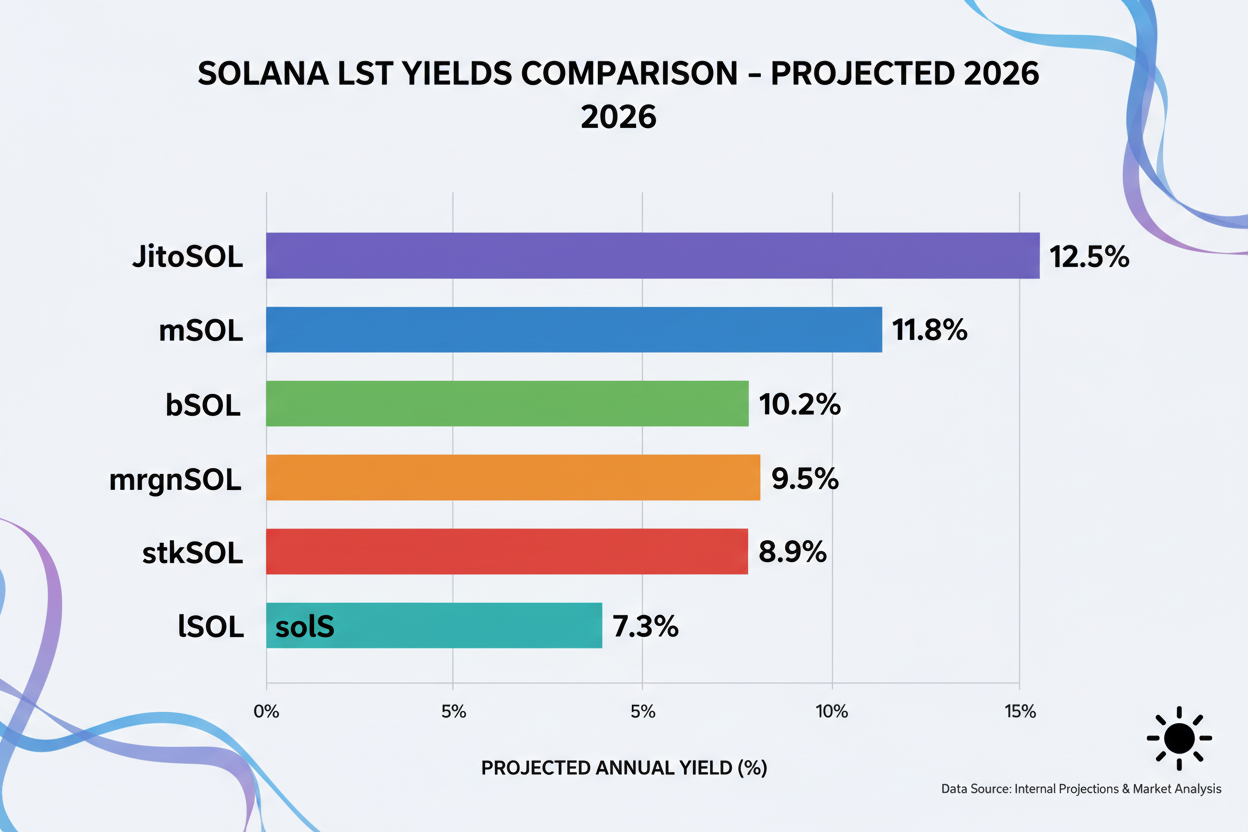
Comparative Analysis: The Top 7 Solana LSTs
To grasp their edges, consider how each protocol positions for 2026’s yield environment. JitoSOL’s MEV integration consistently outperforms, channeling auction revenues back to holders. mSOL’s validator diversity reduces centralization risks, a fundamentals-first priority in my two decades tracking markets. bSOL’s restaking layer adds points-based incentives, appealing to yield optimizers chasing layered returns.
mrgnSOL integrates natively with Marginfi’s lending, enabling collateralized borrowing against staked positions for amplified APYs. stkSOL prioritizes peg stability through algorithmic adjustments, shielding against depegging during downturns. solS excels in execution speed, minimizing opportunity costs in fast-moving DeFi. lSOL’s liquidity pools facilitate seamless swaps, enhancing capital efficiency across DEXs.
Top 7 Solana LSTs Comparison (2026)
| Rank | LST | APY | Key Feature | TVL | Risks |
|---|---|---|---|---|---|
| 1 | JitoSOL | 7.81% | MEV-boosted yields | 💰💰💰💰💰 | MEV centralization & strategy risks |
| 2 | mSOL | 6-8% | Decentralized staking | 💰💰💰💰 | Validator concentration |
| 3 | bSOL | ~7-9% | Restaking points | 💰💰💰 | Amplified slashing risk |
| 4 | mrgnSOL | ~7-9% | Lending collateral | 💰💰 | Liquidation & borrowing risks |
| 5 | stkSOL | ~7-9% | Peg stability | 💰💰 | Depegging potential |
| 6 | solS | ~7-9% | Fast unstaking | 💰 | Unstaking delays & fees |
| 7 | lSOL | ~7-9% | Cross-chain pools | 💰 | Bridge vulnerabilities |
This selection, drawn from Sanctum. so’s 2025-2026 rankings and Nansen’s on-chain data, prioritizes protocols with audited codebases and proven liquidity. As SOL hovers at $126.78, these LSTs offer a buffer against volatility, letting holders capture 6-9.17% base yields while deploying in DeFi.
Navigating Risks in Solana LSD Yield Stacking
No yield comes without scrutiny. liquid staking solana yields amplify returns, yet smart contract exploits and slashing events pose threats. JitoSOL mitigates via MEV insurance, while mSOL’s decentralized validators spread risk. Fragmentation remains a drag; over 14% of staked SOL splinters across silos, breeding slippage on swaps. Sanctum Infinity’s pools address this by aggregating LSTs, but interoperability lags.
Regulatory headwinds loom as institutional inflows like Forward’s fwdSOL and SOL Strategies’ STKESOL accelerate. ETF projections from Laika AI suggest 8-10% yields, but clarity on LST classifications could reshape access. Conservative investors should allocate 20-30% to LSTs, diversifying across JitoSOL for growth, stkSOL for defense, and mrgnSOL for leverage. Historical cycles teach patience; Solana’s Breakpoint 2025 underscored audited frameworks yielding real returns from fees and MEV.
Read more on stacking tactics in our detailed guide: Solana Liquid Staking Tokens APY Surge to 15%: Top LST Yield Stacking Strategies for 2025.
Positioning for 2026: LSTs as Portfolio Anchors
With $8 billion TVL signaling maturity, Solana LSDs fit long-term portfolios emphasizing yield stacking lsd solana. Stack bSOL in restaking for 10% and blends, or loop lSOL through Orca and Kamino for LP alpha. My approach: monitor exchange rates weekly, rebalance quarterly, and cap exposure at 25% amid SOL’s $126.78 consolidation.
These protocols evolve beyond staking, fueling DeFi’s convergence with real-world capital. JitoSOL’s edge in MEV, mSOL’s resilience, and the field’s innovators like solS ensure SOL holders stay liquid, compounded, and ahead. As markets cycle, LSTs prove staking need not mean idleness; they unlock decades of potential from today’s stake.
About the Author