
Choose your liquid staking protocol
To maximize yield in 2026, select a liquid staking protocol that balances security, decentralization, and returns. Liquid staking allows you to earn staking rewards while keeping assets liquid through derivative tokens. This enables you to deploy staked crypto in lending or liquidity pools without sacrificing yield.
The market has consolidated around a few major players. When evaluating options, prioritize protocols with high Total Value Locked (TVL) as a proxy for security and trust. Lower slashing risks and transparent governance are non-negotiable for long-term holdings. Below is a comparison of the leading protocols to help you decide.
| Protocol | TVL (Approx.) | Est. APY | Decentralization |
|---|---|---|---|
| Lido | $25B+ | 3.0-4.5% | Medium (Node Operators) |
| Rocket Pool | $1.5B+ | 3.2-4.8% | High (Minipools) |
| Ether.fi | $1.2B+ | 3.5-5.0% | High (Node Operators) |
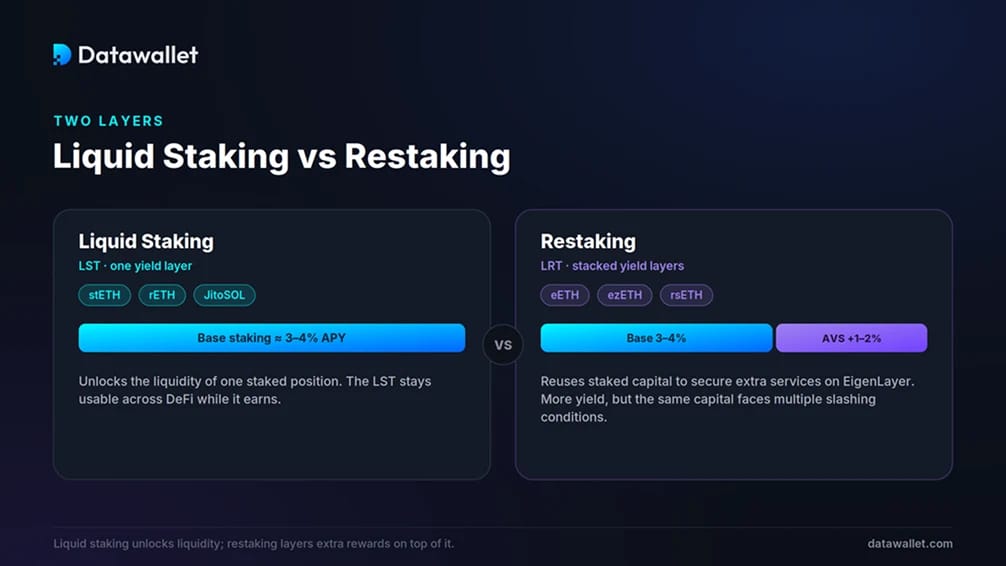
Lido remains the largest liquid staking provider, offering deep liquidity and broad integration across DeFi. Rocket Pool appeals to those seeking higher decentralization through its minipool system. Ether.fi has gained traction by introducing restaking capabilities, allowing users to earn additional yield from Ethereum's security layer. Choose the protocol that aligns with your risk tolerance and yield goals.


As an Amazon Associate, we may earn from qualifying purchases.
Connect wallet and deposit assets
Before you can earn yield, bridge your assets to the correct network and interact with a liquid staking protocol. This process converts native tokens (like ETH or SOL) into liquid staking tokens (LSTs), which represent your staked position and can be utilized in lending or liquidity provision.
1. Connect your wallet
Open a reputable Web3 wallet such as MetaMask, Rabby, or Phantom. Navigate to the dashboard of a trusted liquid staking platform. Click "Connect Wallet" and approve the connection request in your wallet interface. Ensure you are on the correct network (e.g., Ethereum Mainnet, Solana, or Polygon) to avoid sending funds to the wrong chain.
Before depositing, approve the smart contract to spend your tokens. Enter the amount you wish to stake, then click "Approve." A transaction window will appear in your wallet; confirm it and wait for the blockchain to process the approval. This is a one-time action per token type.
Once approved, enter the deposit amount. You can either swap your native tokens directly for LSTs on the platform or deposit them if you already hold them. Review the exchange rate, fees, and estimated APY. Confirm the transaction in your wallet. The platform will lock your assets and mint LSTs to your address.

Navigate to the "Portfolio" or "Assets" tab of the platform. You should see your newly minted LSTs (e.g., stETH, rETH, or mSOL) in your wallet. These tokens accrue rewards automatically. You can now use them in other DeFi protocols while your original stake earns passive yield.
Deploy LSTs in DeFi yield strategies
Once you hold a liquid staking token (LST) like stETH or rETH, it sits idle unless you put it to work. In 2026, the real advantage of liquid staking isn't just the base staking reward; it's the ability to use those tokens as collateral in decentralized finance (DeFi) protocols. This strategy, often called "double-dipping," allows you to earn staking yields while simultaneously generating additional returns through lending or liquidity provision.
Start by identifying a lending protocol that accepts your specific LST as collateral. Leading platforms like Aave or Compound typically offer competitive lending rates for major LSTs. Check the current utilization rate to see how much demand there is for borrowing these assets. Higher utilization usually means better yield for lenders, but also higher risk if the market becomes volatile.
Deposit your LSTs into the lending pool. The protocol will assign a loan-to-value (LTV) ratio, which determines how much you can borrow against your collateral. Most protocols allow you to borrow stablecoins (like USDC or DAI) up to 70-80% of your collateral's value. Borrowing stablecoins is generally safer than borrowing volatile assets because it reduces the risk of liquidation if the crypto market drops.
Take the borrowed stablecoins and pair them with your remaining LSTs (or additional stablecoins) in a decentralized exchange (DEX) liquidity pool. For example, you might create an LST/stablecoin pool on Uniswap or Curve. By providing liquidity, you earn trading fees from the DEX. This adds a third layer of yield on top of your staking rewards and lending interest.
DeFi yields fluctuate daily. Set up alerts for your liquidation price on the lending protocol. If the value of your LST drops significantly, you may need to add more collateral or repay part of the loan to avoid liquidation. Regularly check if the yield from the liquidity pool is still profitable after accounting for trading fees and gas costs.
This strategy transforms your dormant staked assets into an active yield-generating engine. By layering lending and liquidity provision, you maximize the return on your liquid staking 2026 portfolio. Remember that higher yields come with higher complexity and risk. Always start with small amounts to understand the mechanics before committing significant capital.
Monitor smart contract and slashing risks
Liquid staking 2026 protocols offer high yields, but they introduce specific technical risks that direct staking does not. The two biggest threats are slashing events, where validators are penalized for bad behavior, and smart contract vulnerabilities, which can lead to protocol hacks. Because you delegate control to a third-party validator set, your assets are exposed to their operational security.
To mitigate slashing, choose protocols that offer slashing insurance or have a history of transparent incident response. Lido, for example, maintains a staking reserve fund to cover potential slashing losses, protecting stakers from direct financial hit. Always check if the protocol explicitly states how it handles validator misbehavior. If a protocol lacks an insurance fund, assume you bear the full risk of any penalty.
Diversification is your primary defense against smart contract risk. Do not deploy all your staked assets into a single liquid staking token. Spread your exposure across multiple reputable protocols like Lido, Rocket Pool, or Frax. This way, if one protocol suffers a hack or a critical bug, your entire portfolio is not compromised. Treat liquid staking tokens like any other DeFi position: audit the code, verify the treasury, and never over-allocate.
Frequently asked questions about liquid staking 2026
What is the future of liquid staking?
The market for liquid staking is expanding rapidly, with projections indicating growth from USD 198 million in 2025 to USD 572 million by 2032 [[src-serp-1]]. This 16.9% compound annual growth rate suggests that liquid staking 2026 will become a standard infrastructure layer in decentralized finance, offering deeper liquidity and more integrated yield strategies for institutional and retail participants alike.
Is liquid staking worth it?
Yes, for holders planning to keep assets long-term. Protocols like Lido and Rocket Pool issue tokens representing your staked position, allowing you to earn staking rewards while simultaneously using those tokens in other DeFi applications [[src-serp-3]]. This dual utility prevents your capital from sitting idle, effectively maximizing yield on your crypto holdings.
Which liquid staking token offers the highest returns?
Returns vary by network and protocol risk profile. While Lido remains the largest provider by total value locked, newer protocols like Rocket Pool often offer higher base yields to attract liquidity. Short-term price volatility can also impact hourly returns, so it is essential to compare the underlying staking APY against the token's trading premium or discount in the open market.
No comments yet. Be the first to share your thoughts!