
Liquid staking tokens (LSTs) have reshaped the DeFi landscape, offering a flexible bridge between traditional staking and yield farming. In 2025, with Ethereum (ETH) trading at $3,460.15, LSTs like Lido Staked Ether (stETH: $3,455.83), Rocket Pool ETH (rETH: $3,972.71), and Coinbase Wrapped Staked ETH (cbETH: $3,803.91) are not only preserving the value of staked assets but also unlocking new yield opportunities for sophisticated investors.
Why Liquid Staking Strategies Matter in 2025’s DeFi Market
The core appeal of LSTs is simple yet powerful: they allow you to earn staking rewards while maintaining liquidity for further DeFi activities. Instead of locking up your ETH or other proof-of-stake assets, you receive a liquid derivative token that can be deployed across protocols for additional returns. This unlocks a spectrum of advanced strategies designed for those seeking to maximize their risk-adjusted yield.
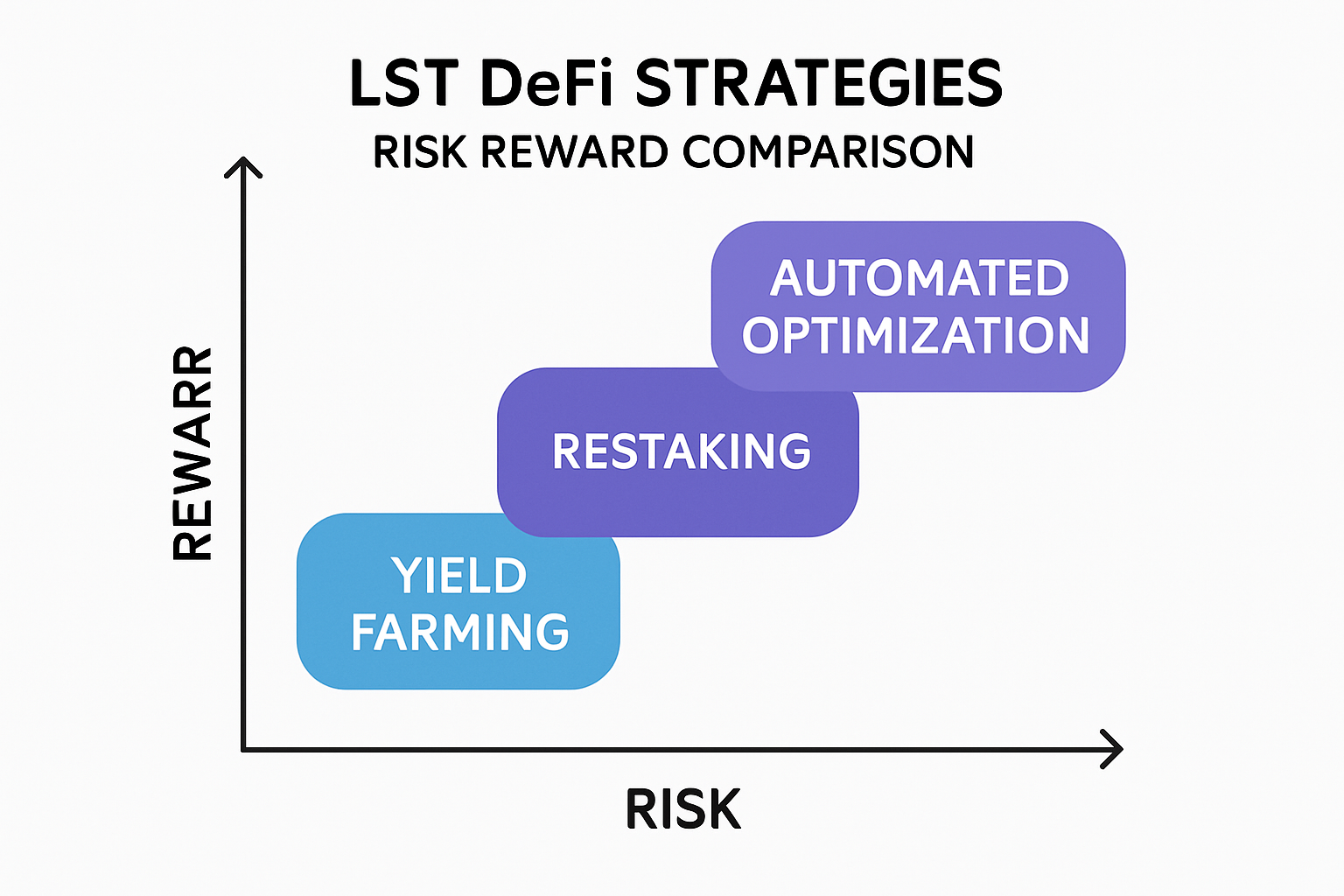
Let’s break down three of the most effective and up-to-date approaches for maximizing yield with LSTs, each with their own risk profile and realistic return range based on current market data:
LST Yield Farming via Blue-Chip Protocols
This strategy is a staple for both newcomers and experienced DeFi yield stackers. Here’s how it works: stake your ETH via a trusted protocol like Lido to receive stETH. Then deploy your stETH into established DeFi platforms such as Curve or Aave. By doing so, you not only earn the base staking rewards but also additional incentives from lending or liquidity mining.
- How it works: Stake ETH → Receive stETH → Deposit stETH in Curve/Aave pools
- Typical APY: 4, 8% (combining staking and DeFi rewards)
- Main risks: Smart contract vulnerabilities, protocol insolvency
This approach is especially popular because it leverages blue-chip protocols known for robust security audits and deep liquidity, though no protocol is entirely risk-free.
Pushing Yield Further: Liquid Staking and Restaking
The next evolution in LST strategies involves restaking, a method gaining traction through protocols like EigenLayer. After acquiring LSTs such as stETH by staking ETH, users can restake these tokens to help secure additional decentralized networks or services built on top of Ethereum.
- How it works: Stake ETH → Receive stETH → Restake on EigenLayer
- Typical APY: 8, 15% (layered rewards from base staking plus restaking incentives)
- Main risks: Increased smart contract exposure, multi-protocol slashing risk
This layered approach can significantly boost returns but comes with heightened risk, the more protocols involved, the broader your vulnerability surface becomes. Investors must weigh potential gains against the chance of slashing events or technical failures across multiple layers.
Ethereum (ETH) Price Prediction 2026-2031: LST and DeFi Yield Context
Forecasted ETH Prices Considering Liquid Staking Token (LST) Adoption, DeFi Trends, and Market Risks
| Year | Minimum Price | Average Price | Maximum Price | YoY % Change (Avg) | Market Scenario Insights |
|---|---|---|---|---|---|
| 2026 | $2,950 | $3,700 | $4,600 | +7% | Consolidation post-LST expansion; minor corrections as regulatory clarity emerges |
| 2027 | $3,200 | $4,200 | $5,400 | +13% | Increased DeFi and LST adoption, but some volatility due to regulatory headwinds |
| 2028 | $3,700 | $5,000 | $6,800 | +19% | Major ETH upgrades, maturing LST protocols, and institutional involvement drive growth |
| 2029 | $4,200 | $5,850 | $7,900 | +17% | Bullish cycle as DeFi/LSTs become mainstream; risks from new competitors |
| 2030 | $4,500 | $6,400 | $9,200 | +9% | ETH cements leadership in DeFi, but faces scalability and cross-chain competition |
| 2031 | $4,100 | $6,850 | $10,500 | +7% | Market matures; innovation pace slows, focus shifts to security and risk management |
Price Prediction Summary
Ethereum’s price is expected to show steady growth from 2026 to 2031, buoyed by the increasing adoption of LSTs and their integration into DeFi protocols. Average prices could rise from around $3,700 in 2026 to about $6,850 in 2031, with maximum bullish scenarios potentially reaching $10,500. Risks remain, especially from regulatory developments, smart contract vulnerabilities, and competition, but ETH is positioned as a primary DeFi asset with strong long-term fundamentals.
Key Factors Affecting Ethereum Price
- Adoption and growth of Liquid Staking Tokens (LSTs) in DeFi
- Major Ethereum network upgrades and scalability solutions
- Evolution of regulatory frameworks for staking and DeFi
- Institutional entry and capital flows into ETH and LSTs
- Competition from other smart contract platforms (e.g., Solana, Avalanche)
- Market cycles, macroeconomic conditions, and risk appetite
- Security incidents, smart contract exploits, or de-pegging events
Disclaimer: Cryptocurrency price predictions are speculative and based on current market analysis. Actual prices may vary significantly due to market volatility, regulatory changes, and other factors. Always do your own research before making investment decisions.
LST Automated Yield Optimization Platforms
If active management isn’t your preference, or if you simply want to capitalize on automation, platforms like Yearn Finance and Instadapp offer automated yield optimization for LST holders. By depositing your stETH or similar tokens into these platforms, algorithms dynamically rebalance funds across various pools to capture the best available yields.
- How it works: Deposit LSTs → Platform rebalances funds automatically among pools/protocols
- Typical APY: 5, 10% (potentially higher during periods of elevated incentives)
- Main risks: Platform dependency, rebalancing inefficiencies during high volatility events
This set-and-forget model appeals to those who prioritize convenience but understand that automation introduces its own dependencies, and does not eliminate underlying market or smart contract risks.
If you’d like a deeper dive into how these mechanisms work together to optimize sustainable returns using liquid staking tokens, see our detailed guide at Yield Stacking in Liquid Staking: How to Optimize Sustainable Returns with LSTs.
Transparency around risk and reward is more important than ever in today’s DeFi environment. While the allure of double-digit APYs is strong, it’s crucial to understand that these figures are not guaranteed and can fluctuate with market conditions, protocol incentives, and broader economic factors. The best investors approach LSTs with a clear-eyed view of both their potential and their pitfalls.
Assessing Real Returns: What Can You Expect?
Based on current market data as of November 8,2025, here’s what realistic returns look like for the three leading LST yield strategies:
- LST Yield Farming via Blue-Chip Protocols: 4, 8% APY by combining staking rewards with DeFi incentives on platforms like Curve or Aave. This range reflects the relatively stable, lower-risk profile of blue-chip deployments.
- Liquid Staking and Restaking: 8, 15% APY when layering base staking yields with additional restaking incentives from protocols such as EigenLayer. Higher returns here are offset by increased complexity and risk exposure.
- Automated Yield Optimization Platforms: 5, 10% APY through dynamic rebalancing across multiple pools using platforms like Yearn or Instadapp, potentially higher during periods of elevated DeFi incentives but subject to platform-specific risks.
These ranges are not static; they ebb and flow based on protocol rewards, token prices (with ETH at $3,460.15, stETH at $3,455.83, rETH at $3,972.71, cbETH at $3,803.91), and overall DeFi market health. Always verify rates directly within each platform before deploying significant capital.
Risk Management: Protecting Your Principal in a Dynamic Market
The most successful LST yield optimizers treat risk management as a core part of their strategy, not an afterthought. Here are some essential practices for safeguarding your assets while pursuing yield:
- Diversify across protocols: Don’t put all your LSTs in one basket; spread exposure to minimize impact from any single protocol failure.
- Favor audited platforms: Prioritize protocols with rigorous security audits and transparent governance processes.
- Monitor de-pegging events: Use alert systems or dashboards to track price deviations between LSTs and their underlying assets in real time.
- Stay informed on regulatory changes: Regulatory clarity around staking is evolving rapidly, especially in major jurisdictions, which can affect both platform operations and user access.
If you’re seeking a comprehensive step-by-step guide tailored to maximizing ETH staking yields with liquid staking tokens in DeFi protocols, visit our resource at How to Maximize ETH Staking Yields with Liquid Staking Tokens in DeFi Protocols.
The Bottom Line: Navigating Opportunity With Caution
LSTs have unlocked a new era of composable yield opportunities for crypto investors who value both liquidity and sustainable returns. Whether you’re leveraging blue-chip protocols for steady APY, layering restaking rewards for higher returns, or automating your strategy through optimization platforms, the key is balancing ambition with prudence. Always do your due diligence, read audits, understand tokenomics, assess slashing risks, and remember that long-term vision beats short-term hype every time.
If you’re ready to deepen your exploration into advanced liquid staking strategies or want actionable tips on sustainable yield stacking using LSTs, explore our expert-driven resources at How Liquid Staking Tokens (LSTs) Enable Sustainable Yield Stacking in DeFi.




No comments yet. Be the first to share your thoughts!