
Get liquid staking 2026 right
Liquid staking lets you earn staking rewards while keeping your assets usable in DeFi. Before you lock anything up, you need to verify two things: the protocol’s security model and the liquidity of the receipt token. Skipping these checks is the fastest way to lose principal.
Start by checking the validator infrastructure. Look for decentralized validator sets rather than single-entity operators. A single point of failure can lead to slashing events that wipe out your yield. Check if the protocol publishes real-time slashing insurance or has a history of covering operator errors.
Next, verify the receipt token’s liquidity. You need to be able to exit or swap the token without significant slippage. Check the total value locked (TVL) in the liquidity pools for that specific token. If the pool is thin, you might get stuck with a token you cannot sell when you need to.
Finally, calculate the net yield after fees. Protocols charge management fees and validator commissions. Subtract these from the gross staking reward to see your actual return. Compare this net yield against the opportunity cost of locking your assets elsewhere. If the net yield is too low, the liquidity premium might not be worth the risk.
How to set up and manage liquid staking
Liquid staking lets you earn staking rewards while keeping your assets usable in the broader decentralized finance ecosystem. Instead of locking your coins and waiting for a validator to pay out, you receive a derivative token that represents your staked position. This receipt token can then be used for lending, trading, or providing liquidity elsewhere. The process is straightforward, but getting the details right ensures you maximize yield without unnecessary risk.
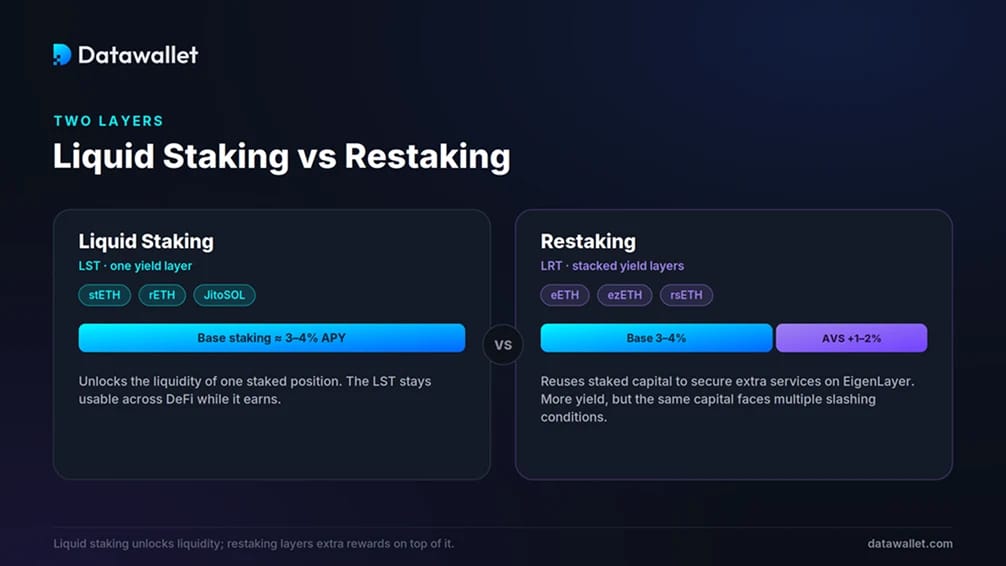
Start by selecting a protocol with a strong track record and transparent operations. Look for established platforms like Lido or Rocket Pool, which have demonstrated security and consistent performance. Check the total value locked (TVL) and the number of active validators to gauge community trust. Avoid newer, untested protocols that promise unusually high yields, as these often carry higher smart contract risks.
Once you have chosen a protocol, connect your cryptocurrency wallet to the platform’s official website. Navigate to the staking interface and select the asset you wish to stake, such as Ethereum or Solana. Enter the amount you want to lock and confirm the transaction. The protocol will then stake your assets on your behalf and mint the corresponding liquid staking token (LST) to your wallet.

Your LST is now ready to generate additional yield. You can deposit it into decentralized lending protocols to earn interest on loans, or add it to liquidity pools on decentralized exchanges. This step is where the "liquid" part of liquid staking shines, allowing you to compound your earnings while your original assets continue to earn staking rewards. Always review the smart contract risks of any DeFi platform you interact with.
Regularly check your portfolio to ensure your yields are performing as expected. Keep an eye on the exchange rate between your LST and the underlying asset, as this reflects the accumulated rewards. If market conditions change or you need liquidity, you can sell your LST on a decentralized exchange or return it to the protocol to redeem your original assets. Staying informed helps you avoid unexpected losses from volatility or protocol changes.
-
Verify protocol security audits and TVL
-
Confirm wallet connection and gas fees
-
Review DeFi platform risks before deploying LST
-
Set up alerts for yield and exchange rate changes
Common liquid staking mistakes
Even with the right protocol, small errors in setup or strategy can erode yields or expose your capital to unnecessary risk. Liquid staking is not a passive income set-and-forget tool; it requires active management of fees, liquidity, and smart contract exposure. Avoid these frequent pitfalls to protect your returns.
Ignoring the real yield gap
Many users chase the highest advertised Annual Percentage Yield (APY) without accounting for the liquid staking token (LST) discount or protocol fees. If an LST trades at a 2% discount to its underlying asset, your effective yield is significantly lower than the headline number. Always calculate the net yield after the discount and any staking service fees. A 5% APY on a token trading at a 3% discount is far less attractive than a 4% APY on a token trading at parity.
Overconcentrating in a single protocol
Diversification is critical in liquid staking. Putting all your assets into one protocol like Lido or Rocket Pool exposes you to single-point-of-failure risks, including smart contract bugs or validator slashing events. Spread your staked assets across two or three reputable protocols. This simple step reduces the impact of any single protocol failure on your overall portfolio.
Neglecting liquidity pool risks
Using your LST in DeFi yield farming introduces new risks. Impermanent loss in liquidity pools can wipe out staking rewards if the underlying asset price moves significantly against your position. Only provide liquidity in pools where you are comfortable holding the underlying asset long-term. If the market turns, you may end up with more of the depreciating asset and less of the stablecoin, negating your staking gains.
Missing rebalancing opportunities
Liquid staking rewards are often distributed in the native staking token, which can fluctuate in value. Regularly check if the yield is being paid in a token that is appreciating or depreciating. If the staking reward token is losing value faster than the staking yield, consider swapping it for a stablecoin or a more stable asset to preserve capital. Set up alerts for significant price deviations to act quickly.
Liquid staking 2026: what to check next
Addressing the practical objections and common uncertainties surrounding liquid staking helps clarify whether this strategy fits your portfolio for 2026. Here are answers to the most frequent questions from investors and developers.
What is the future of liquid staking?
The market is expanding rapidly. Industry projections indicate the global liquid staking market will grow from USD 198 million in 2025 to USD 572 million by 2032, reflecting a strong CAGR of 16.9% [src-serp-1]. This growth is driven by increasing DeFi adoption and the need for capital efficiency across multiple chains.
Is liquid staking worth it?
Yes, if you want to earn passive income without locking up your assets. Protocols like Lido and Rocket Pool give you a receipt token representing your staked position [src-serp-3]. You continue earning staking rewards while using that token elsewhere in DeFi for yield farming or liquidity provision [src-serp-2].
Which liquid staking token will have the highest 1hr return?
No token guarantees the highest short-term return. Returns fluctuate based on network demand, validator performance, and DeFi yield opportunities. Historical data shows that while some tokens spike during high-demand periods, they can also drop quickly. Focus on long-term APY sustainability rather than hourly volatility.
Which crypto will boom in 2026?
While specific predictions vary, Ethereum-based liquid staking tokens remain the market leaders. Lido dominates the space, followed by Rocket Pool and others [src-serp-3]. As the ecosystem matures, multi-chain protocols like Meta Pool are gaining traction by supporting SOL, NEAR, and other major assets [src-serp-6]. Always research individual protocols before committing funds.
Helpful gear
Use these product recommendations as a starting point, then choose the size, material, and price point that fit how you actually use the gear.



As an Amazon Associate, we may earn from qualifying purchases.
No comments yet. Be the first to share your thoughts!