
Liquid staking market outlook 2026
The liquid staking sector is expanding rapidly, driven by the demand for yield-bearing assets that remain liquid within decentralized finance. According to Intel Market Research, the global market was valued at USD 168 million in 2024 and is projected to grow from USD 198 million in 2025 to USD 572 million by 2032 [[src-serp-1]]. This trajectory reflects a compound annual growth rate (CAGR) of 16.9%, signaling strong institutional and retail adoption as Ethereum and other proof-of-stake networks mature [[src-serp-7]].
This growth is not merely speculative; it is underpinned by the functional utility of liquid staking derivatives (LSDs). Protocols like Lido and Rocket Pool allow users to stake their assets while retaining the ability to use the resulting tokens in other DeFi applications, such as lending or liquidity provisioning. This dual utility creates a sticky ecosystem where capital is both secured and productive.
As the market scales, the competitive landscape is shifting from simple yield generation to more complex financial primitives. The entry of restaking protocols like EigenLayer has added a new layer of complexity and potential yield, further consolidating the market's growth narrative. Investors and users are increasingly looking for platforms that offer not just returns, but robust security and composability within the broader DeFi infrastructure.
Lido stETH yield and liquidity
Lido remains the dominant force in liquid staking, holding the largest market share for Ethereum staking derivatives. As the primary option for users seeking yield without sacrificing liquidity, stETH functions as a foundational asset in decentralized finance. Its widespread adoption creates a network effect that smaller protocols struggle to match.
The yield on stETH closely tracks the base Ethereum staking rate, currently hovering around 4.11% according to real-time reward data. Unlike fixed-yield products, this rate fluctuates with network activity and validator performance. Lido distributes rewards automatically, compounding value in the token itself rather than requiring manual claims.
Liquidity is Lido’s strongest advantage. stETH is listed on nearly every major centralized exchange and integrated into thousands of DeFi protocols. This deep liquidity allows users to sell or trade their staked assets instantly, a feature that is often impossible with direct staking or locked validator positions. The ease of exit reduces opportunity cost, making it a preferred choice for active traders and long-term holders alike.
While dominance brings convenience, it also concentrates risk. Lido controls a significant portion of the total Ethereum staking supply. Users must weigh the benefit of immediate liquidity against the potential systemic risks associated with such a large single entity. For most investors, however, the balance between yield and accessibility makes Lido the default entry point for liquid staking.
Decentralization Benefits of Rocket Pool
Rocket Pool positions itself as the decentralized alternative to Lido, prioritizing node operator diversity over sheer scale. While Lido remains the largest liquid staking provider by total value locked, Rocket Pool operates as a medium-sized, community-governed protocol. This structural difference is not just philosophical; it directly impacts how the network distributes risk and rewards among its participants.
The core of Rocket Pool’s value proposition lies in its node operator model. Unlike centralized validators that run on a few large servers, Rocket Pool relies on a distributed network of individual operators. Each operator must stake a minimum amount of RPL tokens as collateral, aligning their financial interests with the security of the network. This setup ensures that no single entity controls a significant portion of the staked Ethereum, reducing the risk of systemic failure or censorship.
This decentralization creates a more resilient ecosystem. If one node operator goes offline or acts maliciously, the impact is isolated and mitigated by the protocol’s insurance pool, funded by the RPL collateral. For users, this means their staked assets are not reliant on the uptime of a single corporate entity. Instead, the network’s health depends on the collective participation of thousands of independent operators.
The economic incentives further reinforce this model. Node operators earn rewards from both the base staking yield and additional fees generated by their nodes. This dual-income stream encourages high-quality infrastructure and active participation. As the liquid staking market grows, projected to reach $572 million by 2032, protocols like Rocket Pool offer a compelling option for those who prioritize decentralization and community governance over maximum convenience.
EigenLayer restaking strategies
EigenLayer introduced restaking to the Ethereum ecosystem, allowing users to reuse their staked ETH to secure additional "Actively Validated Services" (AVS). Instead of locking capital for a single purpose, restakers provide shared security to protocols like oracles, bridging solutions, and sequencers. This mechanism aims to increase capital efficiency by monetizing idle staked assets.
Lock ETH in the EigenLayer contract to earn standard Ethereum staking rewards.
Choose which Active Validated Services you want to help secure, such as an oracle network or a decentralized sequencer.

Receive additional yield from the AVS protocols on top of your base Ethereum staking rewards.
The protocol uses a points system to incentivize early adoption and liquidity provision. Points are awarded based on the amount of restaked ETH and the duration of the commitment. While these points do not currently have direct monetary value, they serve as a proxy for future governance rights or potential airdrops, encouraging users to lock capital for longer periods.

Restaking amplifies risk alongside yield. If a restaker's validator behaves maliciously or fails to perform its duties for an AVS, they face slashing penalties. Crucially, slashing on an AVS can result in the loss of the underlying staked ETH, meaning a single failure can impact rewards across multiple secured services. This creates a complex web of interdependent smart contract risks that users must understand before participating.
The EIGEN token price reflects market sentiment around restaking adoption. Traders monitor the token closely as it serves as the governance and utility backbone of the EigenLayer ecosystem. Volatility in the token price often correlates with changes in the total value secured by the protocol and the launch of new AVS partnerships.
Yield and risk comparison
Choosing a liquid staking protocol requires balancing potential returns against the complexity of the underlying infrastructure. While Lido offers deep liquidity and broad adoption, Rocket Pool provides a more decentralized node operator network, and EigenLayer introduces restaking risks that can amplify both rewards and exposure to smart contract vulnerabilities. Understanding these trade-offs helps you align your staking strategy with your specific risk tolerance.
The following table breaks down the core metrics for each protocol, focusing on the real reward rates and the structural risks inherent to each model. Note that yield is dynamic and fluctuates based on network activity and MEV (Maximal Extractable Value) opportunities.
| Protocol | Primary Yield Source | Decentralization Model | Risk Profile |
|---|---|---|---|
| Lido | ETH staking + MEV boost | DAO-governed, large node operators | Low smart contract risk, high centralization concern |
| Rocket Pool | ETH staking + MEV boost | Community-run node operators | Low centralization risk, moderate complexity |
| EigenLayer | Restaking AVS rewards + ETH staking | Newer, evolving operator set | High smart contract and slashing risk |
Lido remains the dominant choice for those prioritizing ease of use and liquidity, as its stETH token is widely integrated across DeFi platforms. However, its reliance on a few large node operators has drawn scrutiny regarding centralization. Rocket Pool addresses this by requiring a minimum stake for node operators, fostering a more distributed network, though this can lead to slightly lower yields during periods of low MEV activity. EigenLayer sits apart by allowing users to restake their liquid staking tokens to secure additional services (AVSs). This creates a new yield layer but introduces significant complexity and potential slashing risks if the AVS operators misbehave.
Liquid staking FAQ 2026
What is the future of liquid staking?
The global liquid staking market is expanding rapidly, projected to grow from USD 198 million in 2025 to USD 572 million by 2032. This 16.9% CAGR reflects a strong industry shift toward DeFi liquidity integration, where staked assets remain active rather than locked away. As protocols like Lido and Rocket Pool mature, the sector is moving from niche experimentation to a core component of institutional crypto strategy.
Is liquid staking worth it?
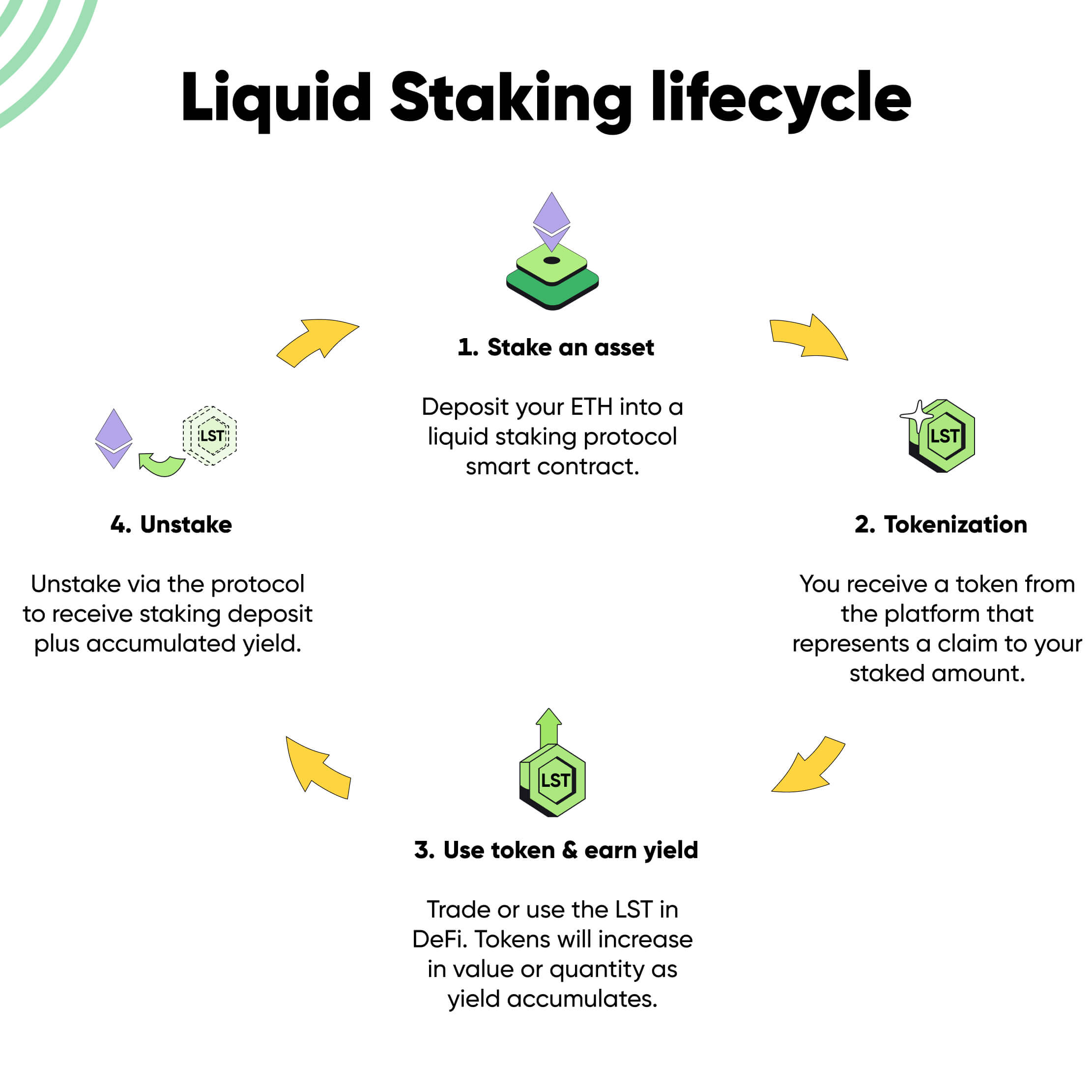
Liquid staking is worth it if you want to earn passive income while maintaining exposure to DeFi opportunities. Unlike traditional staking, which locks your tokens, liquid staking issues a derivative token representing your staked position. You can use this token to earn additional yields in lending markets or liquidity pools, effectively stacking rewards on your initial stake.
Which liquid staking token has the highest return?
Yield rates vary by network, with BNB and Cosmos currently offering some of the highest real reward rates. As of early 2026, BNB leads at approximately 7.43%, followed by Cosmos at 6.95% and Polkadot at 6.11%. Ethereum, the primary focus of Lido and Rocket Pool, offers a real reward rate of 4.11%. These rates fluctuate based on network activity and validator performance.
No comments yet. Be the first to share your thoughts!