
What liquid staking actually is
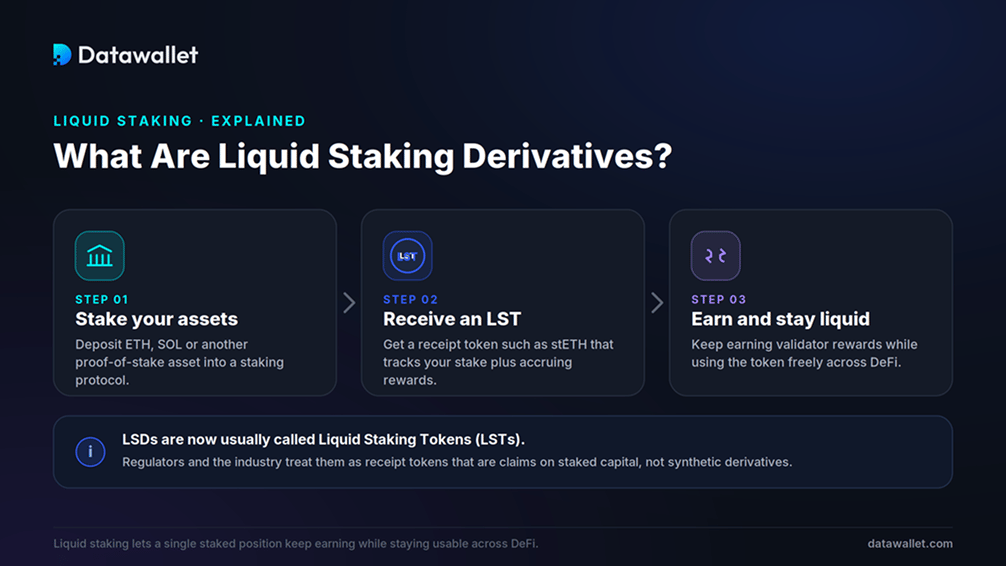
Liquid staking solves the liquidity trap of traditional staking. When you stake crypto directly on a network like Ethereum, your tokens are locked to secure the blockchain, and you cannot access them until the lockup period ends. Liquid staking protocols change this by issuing a derivative token that represents your staked position. You still earn staking rewards, but you hold a tradable asset that you can use elsewhere.
For example, if you stake ETH through a protocol like Lido, you receive stETH in return. This token tracks the value of your underlying ETH plus accrued rewards. Because stETH is an ERC-20 token, you can trade it on exchanges or supply it to other DeFi protocols to earn additional yield, effectively using your capital twice.
This mechanism bridges the gap between security and flexibility. Instead of letting your assets sit idle, you maintain exposure to the network’s growth while retaining the freedom to manage your portfolio. As the industry evolves, this model has become a cornerstone of decentralized finance, allowing capital to remain active rather than dormant.
Choose your staking protocol
Selecting the right liquid staking protocol determines the derivative token you receive and the specific risks you assume. Your choice should align with your primary asset—such as Ethereum or Solana—and your comfort level with centralization. The protocol you pick dictates the yield structure and the liquidity options available to you.
Compare top protocols
The landscape is dominated by a few key players, each offering distinct trade-offs between decentralization, yield optimization, and supported chains. Lido remains the largest provider for Ethereum, while Jito has emerged as a leader for Solana by integrating MEV (Maximum Extractable Value) rewards. Rocket Pool offers a more decentralized alternative for Ethereum stakers. Use the comparison below to evaluate these options side-by-side.
| Protocol | Primary Chain | Key Feature | Decentralization |
|---|---|---|---|
| Lido | Ethereum | Largest TVL & Multi-Chain | Moderate |
| Rocket Pool | Ethereum | Node Operator Network | High |
| Jito | Solana | MEV-Boosted Yields | Moderate |
Evaluate risk and rewards
Higher yields often come from additional revenue streams like MEV, which Jito leverages for Solana. However, this can introduce complexity. Lido’s dominance provides liquidity but raises centralization concerns for some purists. Rocket Pool’s node-operator model distributes control more broadly. Choose based on whether you prioritize maximum yield or decentralized security.
Verify official sources
Always verify protocol details through official documentation. Lido’s documentation outlines its multi-chain expansion. Jito’s whitepaper explains its MEV distribution mechanism. Rocket Pool’s node operator guide details its decentralized validator requirements. Avoid relying on third-party summaries for security-critical decisions.
Execute the staking transaction
Converting native assets into liquid staking tokens (LSTs) is a straightforward swap, but the mechanics require precision to avoid unnecessary costs or failed transactions. Unlike traditional staking where you delegate directly, liquid staking involves an immediate exchange: you send your native coin (like ETH or SOL) to the protocol, and the protocol mints a representative token (like stETH or mSOL) back to your wallet.
Follow this workflow to ensure your transaction settles correctly and your liquidity remains intact.
Navigate to the official interface of your chosen liquid staking protocol (e.g., Lido, Rocket Pool, or Jito). Ensure you are on the correct domain to avoid phishing sites. Click "Connect Wallet" and authorize the connection. Verify that the network selector in your wallet matches the chain the protocol operates on (e.g., Ethereum Mainnet, Solana, or Polygon).
Choose the native asset you wish to stake. Enter the amount you want to convert. The interface will display the estimated amount of LSTs you will receive. Be aware that the exchange rate is rarely 1:1; for example, 1 ETH might yield 0.98 stETH initially, with the ratio improving as staking rewards accrue. Ensure you have enough native tokens to cover the staking amount plus the network gas fees.
Before confirming, check the transaction details. Set your slippage tolerance appropriately; for LST swaps, a standard 0.5% to 1% is usually sufficient, but adjust if the market is volatile. Review the network gas fees. If the fee is unusually high, consider waiting for a lower-traffic period. This step prevents your transaction from failing due to price movement between approval and execution.
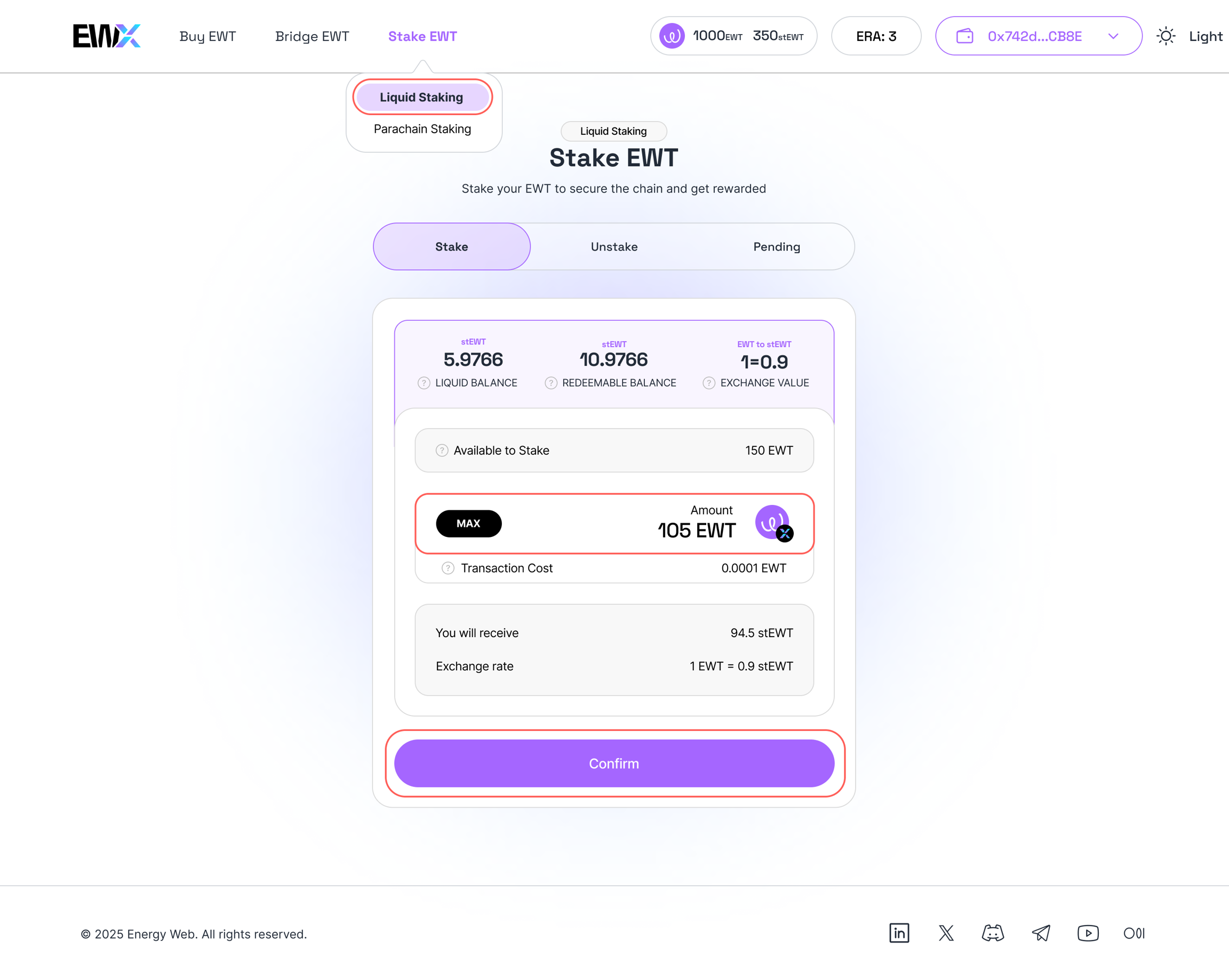
Review the summary: you are sending [Asset A] and receiving [LST Token]. Click "Swap" or "Stake" and confirm the transaction in your wallet. Wait for the block confirmation. Once confirmed, the LSTs will appear in your wallet balance. You can now use these tokens in other DeFi protocols while your original assets continue to earn staking rewards in the background.
This process transforms idle capital into a yield-bearing asset that retains liquidity. By following these steps, you maintain control over your assets while participating in the growing liquid staking ecosystem.
Deploy your liquid staking token
You now hold the liquid staking token (LST) in your wallet. This token represents your staked assets and accrues staking rewards over time, but its true value lies in its liquidity. Instead of letting the LST sit idle, you can deploy it into decentralized finance (DeFi) protocols to compound your yield further.
This step transforms your static staking rewards into a dynamic, multi-layered income stream. By supplying your LST to lending markets or liquidity pools, you earn additional trading fees or interest on top of the base staking yield.
Choose a lending protocol
Start by identifying a reputable lending protocol that supports your specific LST. Major platforms like Aave or Compound often list top LSTs such as stETH or rETH. Ensure the protocol has a strong track record and sufficient liquidity for your asset.
Supply your LST
Connect your wallet to the chosen protocol and navigate to the deposit interface. Enter the amount of LST you wish to supply. Review the current interest rates and any applicable fees before confirming the transaction. Once supplied, you will typically receive a receipt token representing your position.
Monitor and manage risk
Continuously monitor your position, especially if you use borrowed assets against your LST. Keep an eye on the health factor to avoid liquidation. If the value of your collateral drops significantly, you may need to add more assets or repay debt to maintain your position.
Manage smart contract and depeg risks
Liquid staking introduces two distinct hazards that can erode your yield or principal: smart contract vulnerabilities and depegging events. Unlike standard staking, where you simply wait for rewards, liquid staking requires you to trust code to manage your assets while maintaining a peg to the underlying network token.
Smart contract bugs are the most immediate threat. Liquid staking protocols (LSTs) rely on complex code to handle staking, rewards distribution, and token minting. A single vulnerability can lead to exploits or total loss of funds. To mitigate this, only use protocols that have undergone rigorous, public audits from reputable firms. Avoid new or unaudited platforms, no matter how high the advertised yield.
Depegging occurs when the liquid staking token trades below a 1:1 ratio with the underlying asset, such as ETH. This can happen during market stress or if the protocol’s reserves are insufficient to back the tokens. If you notice your LST trading at a significant discount, consider withdrawing to native assets to preserve principal rather than holding a depreciating asset.
Slashing events are another risk specific to proof-of-stake networks. If the validators operated by the LST protocol behave maliciously or go offline, the network may "slash" (penalize) a portion of the staked funds. While reputable protocols often have insurance funds or slashing protection mechanisms, you should verify if your chosen protocol covers these losses. Understanding the slashing policies is as important as checking the audit status.
Frequently asked questions about liquid staking
What is the future of liquid staking?
The market is expanding rapidly. Industry data projects the global liquid staking market to grow from USD 198 million in 2025 to USD 572 million by 2032, reflecting a compound annual growth rate (CAGR) of 16.9%. This trajectory suggests strong long-term viability as DeFi liquidity requirements increase.
Which liquid staking token offers the highest returns?
Yields vary significantly by blockchain network. Current real reward rates show BNB leading at 7.43%, followed by Cosmos at 6.95% and Polkadot at 6.11%. Ethereum, the most common liquid staking asset, currently offers a real reward rate of 4.11%, while networks like Polygon and Avalanche offer lower yields of 2.58% and 2.47% respectively.
Is liquid staking worth it?
Liquid staking allows you to earn passive income on long-term holdings while maintaining flexibility. Protocols like Lido and Rocket Pool issue a token representing your staked position, enabling you to use that asset elsewhere in DeFi. This dual utility makes it a practical strategy for investors who want yield without locking up their capital.
Helpful gear
Use these product recommendations as a starting point, then choose the size, material, and price point that fit how you actually use the gear.


As an Amazon Associate, we may earn from qualifying purchases.
No comments yet. Be the first to share your thoughts!