
What liquid staking actually does
Liquid staking solves the liquidity trap of traditional staking. When you stake assets directly on a proof-of-stake network, your tokens are locked to secure the chain. This provides security and yield, but it ties up your capital, preventing you from using those funds elsewhere. Liquid staking changes this dynamic by issuing a receipt token that represents your staked position.
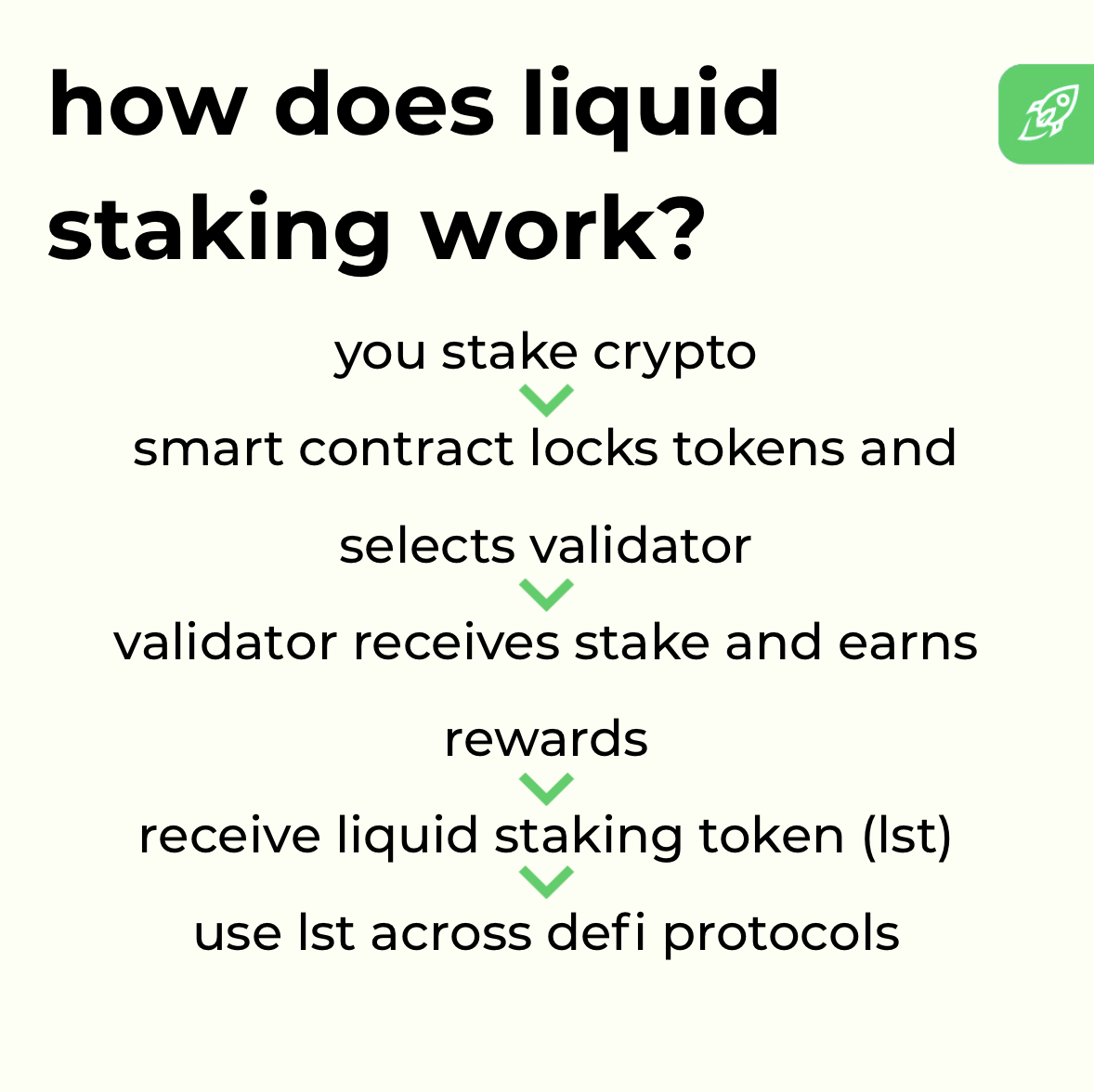
This receipt token, often called a liquid staking token (LST), tracks the value of your underlying stake plus accrued rewards. You can trade, transfer, or use this token as collateral in decentralized finance (DeFi) protocols while your original assets continue to earn staking rewards. This dual benefit allows you to maintain exposure to the asset’s price appreciation and yield generation without sacrificing flexibility.
The trade-off is straightforward: you accept slightly lower yields compared to native staking in exchange for immediate liquidity and composability. Instead of waiting for withdrawal periods to pass, you can deploy your staked value across lending markets, liquidity pools, or other yield strategies. This makes liquid staking a practical tool for maximizing capital efficiency in a DeFi environment.
Choose a liquid staking protocol
Selecting the right liquid staking protocol requires balancing security, decentralization, and cost. Your choice determines how your staked assets are managed and what fees you pay on rewards. A comparison table below helps you evaluate the top options side-by-side.

| Protocol | Network | Staking Fee | Min. Stake | Decentralization |
|---|---|---|---|---|
| Lido | Ethereum | 10% | None | High |
| Rocket Pool | Ethereum | 5% | 0.01 ETH | Very High |
| Jito | Solana | 7% | None | Medium |
| Marinade | Solana | 4% | None | Medium |
Lido remains the largest liquid staking protocol by total value locked, offering deep liquidity and broad DeFi compatibility. Rocket Pool provides a lower fee structure and a more decentralized validator network, which may appeal to users prioritizing censorship resistance. For Solana users, Jito and Marinade offer competitive yields with varying fee structures and minimum stake requirements.
When evaluating these options, consider the protocol's track record and security audits. Higher decentralization scores often correlate with better long-term resilience, while lower fees can significantly impact net rewards over time. Always verify the official documentation for the most current fee schedules and minimum stake amounts.
Deposit assets and receive tokens
To begin liquid staking, you must interact directly with a supported protocol interface. This process involves connecting your wallet, approving the token spend, and depositing your assets to receive liquid staking tokens (LSTs) in return. These tokens represent your staked position and can be used immediately in other DeFi applications.
Navigate to the official website of your chosen liquid staking protocol. Locate the "Connect Wallet" button, typically found in the top-right corner of the interface. Select your wallet provider (e.g., MetaMask, Phantom) and confirm the connection request in your wallet extension. Ensure you are on the correct network (e.g., Ethereum Mainnet for ETH, Solana for SOL) before proceeding.
When you first interact with a protocol, you must approve it to spend your tokens. Click the "Approve" or "Allow" button next to the asset you wish to stake. A transaction prompt will appear in your wallet; review the gas fees and click "Confirm." This approval is a one-time action per token type on most protocols, allowing the smart contract to manage your deposit.

Enter the amount of cryptocurrency you want to stake into the deposit field. Verify that the correct asset is selected (e.g., ETH, SOL, or USDC). Click "Deposit" or "Stake." Your wallet will prompt you to sign the transaction. Once confirmed on the blockchain, your assets are delegated to the protocol's validators and locked for staking.
After the transaction is confirmed, the protocol will mint and send the corresponding liquid staking tokens (LSTs) to your wallet. For example, depositing ETH into Lido yields stETH, while depositing into Rocket Pool yields rETH. These tokens will appear in your wallet balance, representing your staked position plus accrued rewards.
The liquid staking tokens you receive are ERC-20 (or SPL on Solana) tokens that maintain a 1:1 peg with your deposited asset, plus a small premium for staking rewards. You can hold these tokens in your wallet or transfer them to any exchange or DeFi platform that supports them. This liquidity is the core advantage of liquid staking, allowing you to earn yield while retaining access to your capital.
Always verify the protocol's official URL and smart contract addresses before connecting your wallet. Phishing sites often mimic legitimate interfaces to steal funds. Stick to well-known platforms like Lido, Rocket Pool, or Coinbase as recommended by major wallet providers like MetaMask.
Deploy liquid tokens in DeFi
Once you hold liquid staking tokens (LSTs), you can unlock additional yield by deploying them in decentralized finance (DeFi) protocols. This strategy turns idle staked assets into active collateral, effectively stacking yield on top of your base staking rewards. As noted by Chainlink, this process allows users to preserve the benefits of staking while using the tokenized assets as collateral across various DeFi applications.
Supply as Collateral
The most straightforward way to generate extra yield is to supply your LSTs to lending markets. By depositing tokens into protocols like Aave or Compound, you earn interest from borrowers who use your assets for leverage or shorting. Your LST continues to accrue staking rewards in the background, while the lending protocol distributes borrowing interest to you in real-time. This creates a dual-income stream: passive staking yield plus active lending interest.
Provide Liquidity
For higher potential returns, you can provide liquidity to decentralized exchanges (DEXs) like Uniswap or Curve. Adding your LST to a trading pair, such as LST/ETH, allows you to earn a share of the trading fees generated by the pool. However, this approach carries impermanent loss risk if the price of the LST diverges significantly from the paired asset. It is essential to monitor the peg stability of your LST to ensure the liquidity provision remains profitable.
Monitor depeg Risks
While leveraging LSTs amplifies yield, it also exposes you to smart contract and depegging risks. Always review the audit history and total value locked (TVL) of the DeFi protocol before depositing. Stick to established, audited platforms to minimize the chance of capital loss due to protocol exploits or severe market volatility.
Manage depegging and slashing risks
Liquid staking introduces two unique failure modes that native staking avoids: price decoupling and validator penalties. When the receipt token trades below its underlying asset, you face immediate unrealized losses even if the underlying staking rewards remain healthy. This is known as depegging.
Depegging often occurs during market stress or when a protocol’s total value locked (TVL) drops sharply. If you are using your LST as collateral in DeFi, a sharp depeg can trigger liquidation cascades. To monitor this, check the LST-to-underlying price ratio on major aggregators and set alerts for deviations greater than 1%.
Slashing is the second risk. If the validator you delegated to acts maliciously or goes offline, the protocol may confiscate a portion of your staked assets. While most liquid staking protocols have slashing insurance funds, these are not guaranteed. Always verify the protocol’s slashing history and insurance coverage before depositing.
-
Monitor protocol TVL trends weekly
-
Set price alerts for LST depegging
-
Review validator performance and slashing history
-
Verify insurance fund coverage limits
No comments yet. Be the first to share your thoughts!